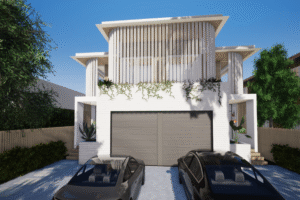
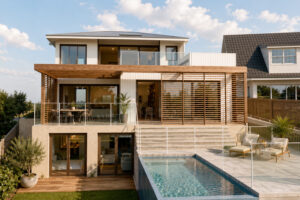
A Passive Solar house or ‘Passive design’ optimises a building’s solar exposure to produce the most comfortable indoor environment while using the least amount of energy. This approach incorporates the following elements: orientation, shading, glazing, natural ventilation, thermal mass and thermal insulation.
The Passivhaus model mandates specific techniques and standards to produce an airtight building with controlled ventilation. Houses built to this standard are ultra-high preforming, offering year-round thermal comfort, excellent indoor air quality and very low energy consumption. Indoor temperatures are highly stable, fluctuating in a narrow band between 21 and 25 degrees, throughout the year with minimal use of air cooling or heating systems. Passive house designs utilise five basic principles: thermal insulation, airtightness, high-performance windows/ doors, ventilation with heat recovery system, and thermal bridge reduced design.
Passive vs active
The main difference between a Passive House and a Passive Solar home is seen in the ventilation and airtightness of the buildings. Passive Solar designs rely on natural ventilation, whereas Passive Houses are mechanically ventilated using either a Heat Recovery Ventilation (HRV) system or an Energy Recovery Ventilation (ERV) system to distribute fresh, filtered air throughout the home 24/7. Ventilating a Passive Solar house requires the active involvement of its occupants to open and close windows and doors, whereas a Passive House is self-ventilating.
There is a common myth that windows in a Passive Houses can’t be opened. This is untrue. There is no reason not to open the house up on a beautiful day. But when it is too cold or hot outside, your snug, airtight Passive House will maintain a comfortable indoor temperature with little need for heating or air conditioning.
Passive Houses are healthy, economical and sustainable but they do require specialist expertise and precision construction by Passivhaus-certified builders and designers. If that isn’t a viable option, outstanding results are still attainable. By combining aspects of Passive Solar design with Passive House principles, it is possible to achieve a net-zero outcome in your new build, meaning the home will produce as much clean energy as it uses annually.
Graphic: ©Passivhaus Institut